
In January 2026, the Bolivian government updated key regulations for the national energy sector. On January 12, Supreme Decree (D.S.) No. 5516 was enacted, repealing D.S. No. 5503 and introducing a package of measures aimed at stabilizing prices of hydrocarbon derivatives, along with social, tariff and financial provisions related to the supply emergency.
Additionally, on January 13, 2026, Supreme Decree (D.S.) No. 5517 was enacted, aiming to ensure the supply of fuels and energy, as well as to reactivate production activity in the country.
Below we provide a summary of the regulatory measures included in each decree.
Supreme Decree 5516
Stabilization of consumer prices of products for the domestic market
This decree establishes new final consumer prices for petroleum-derived products. The table below compares the current prices with the previous ones:
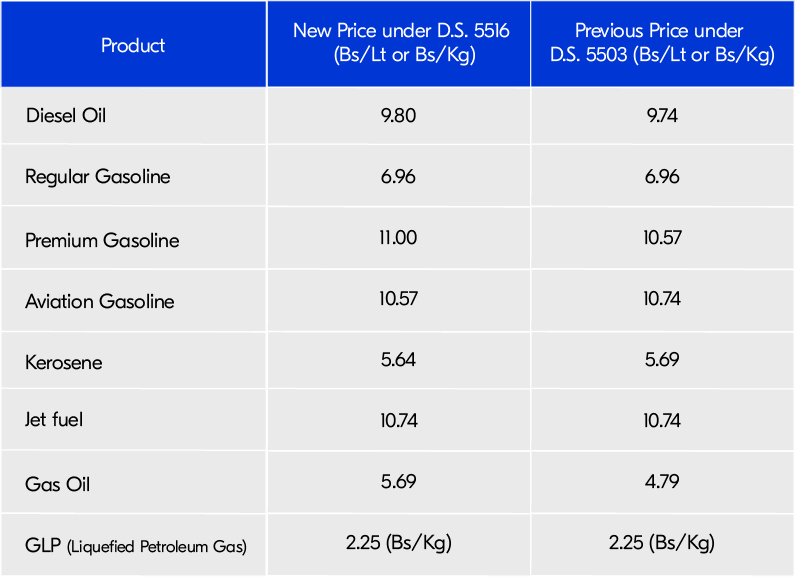
These prices will remain in effect for a transition period of six (6) months following publication of the decree. After this period, prices will be calculated in accordance with the Regulations on Petroleum-Derived Product Prices, as provided in Supreme Decree No. 5516.
Final Price of Compressed Natural Gas (CNG ) for Vehicles
The final consumer price for Compressed Natural Gas (CNG) has been set at 2.73 Bs/m³, with a retail distribution margin of 1.1247 Bs, including VAT.
These prices will remain in effect for a transition period of six (6) months from the date of publication of the decree. Once this period has concluded, prices will be calculated in accordance with the Regulations on the Pricing Regime for Compressed Natural Gas (CNG), as provided in Supreme Decree No. 5516.
Natural Gas Price at the City Gate
For regulatory purposes, the term City Gate refers to the regulated point in the transportation system where natural gas is delivered by the transporter to the distributor, from which the gas enters the urban distribution network for sale to end users.
The regulations establish maximum limits on the City Gate price of natural gas, differentiated according to type of user:
- For the distribution of natural gas through pipeline networks, excluding CNG, the City Gate price may not exceed USD 0.98 per MPC, in accordance with current regulations.
- For CNG users, the City Gate price shall not exceed 50% of the minimum natural gas export price, plus the domestic pipeline transportation tariff.
The National Hydrocarbons Agency (ANH) shall publish the applicable City Gate price for CNG users on a quarterly basis.
Financing of Electricity Generation with Gas Oil in Isolated Systems
As a consequence of the increase in the price of gas oil, 60% of the payment made for electricity by non-regulated consumers—those with specific power demand who contract directly with vertically integrated isolated system distributors—will be temporarily allocated directly to the bank accounts of the isolated systems that generate electricity with gas oil.
This measure will remain in effect until the full amount of lost revenue resulting from the increase in the new gas oil price is recovered, at which point such payment will revert to the Wholesale Electricity Market (MEM) Stabilization Fund.
The Electricity and Nuclear Technology Regulatory Authority (AETN) will regulate this transitional financing scheme for electricity generation with gas oil in isolated systems, including mechanisms for calculating and publishing the pertinent amounts monthly.
Supreme Decree 5517
Under this decree, the government declared an Energy and Social Emergency throughout Bolivia, as a consequence of the ongoing inflationary process and the shortage of dollars and fuels affecting the country.
As a result, two key measures were issued:
Authorization for individuals or private legal entities to import, sell and market fuels
The decree authorizes any individual or private legal entity to import and market petroleum-derived products at import and/or pre-terminal (storage terminal gate) prices, provided they have their own or leased storage capacity.
Suspension of Diesel from List of Controlled Substances
Diesel has been removed from the List of Controlled Substances, and the requirement for Prior Authorization (PA) from the General Directorate of Controlled Substances (DGSC) has been suspended.
This provision will remain in effect for one (1) year from approval of the administrative resolution by the ANH that adjusts the import procedures.
Conclusions
Both Supreme Decrees largely maintain the energy sector measures established in D.S. 5503, consolidating an exceptional regulatory framework for the energy sector.
Through these measures, the Government: (i) establishes a price stabilization system for hydrocarbon-derived products and CNG by eliminating the state subsidy, and (ii) expands private sector participation in the fuel supply chain, particularly through authorization for importation and marketing at import or pre-terminal prices.
Taken together, these measures represent a shift toward a more flexible model for managing the fuel market, aimed at ensuring domestic supply and mitigating the effects of foreign currency constraints, whose effectiveness will depend on proper implementation and regulatory oversight.